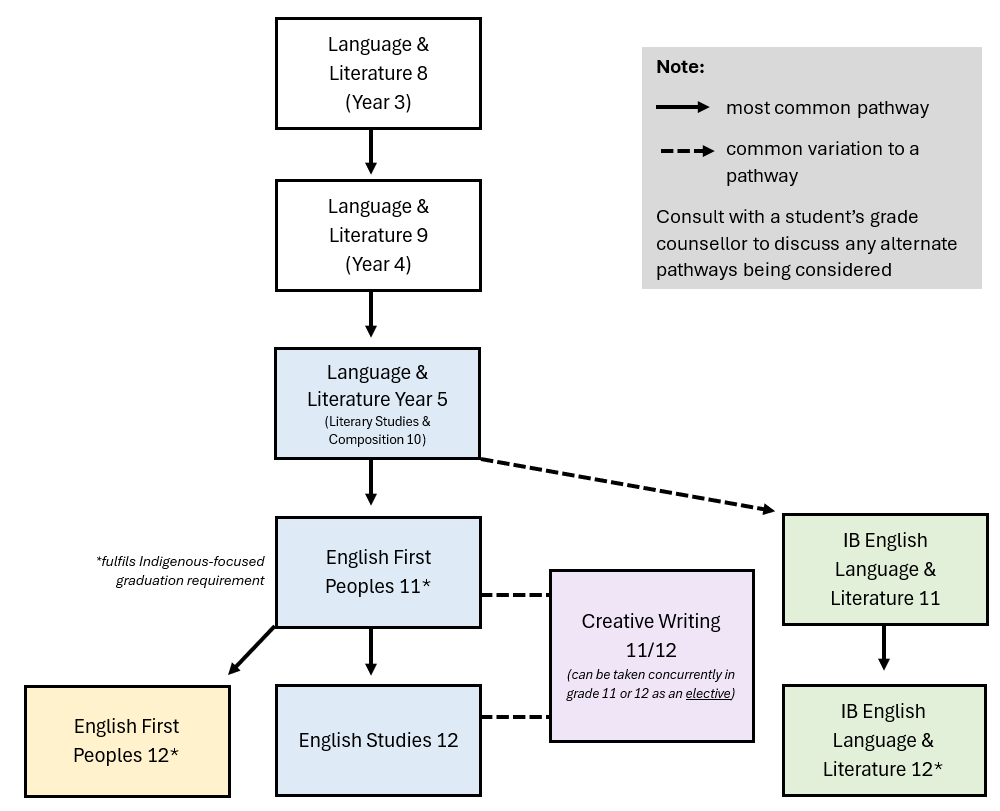
LANGUAGE & LITERATURE YEAR 3 / ENGLISH LANGUAGE ARTS 8
Students will explore the writing process through a variety of means: journal entries, expository paragraphs, narrative stories, dramatic scripts, poetic forms, notes and letters. Students will also investigate a variety of literary forms and genres, which may include: short stories, poetry, plays, novels (historical and contemporary) and mythology. Oral skills will be enhanced through a variety of formal and informal discussions, debates, speeches and dramatic presentations. The course also includes: research skills, vocabulary building, spelling rules, parts of speech, sentence types and punctuation.
LANGUAGE & LITERATURE YEAR 4 / ENGLISH LANGUAGE ARTS 9
English 9 explores a variety of writing styles and places emphasis on the importance of literature. Throughout the school year, students review paragraph writing and focus on the expository (compare and contrast) essay format. The mechanics of syntax and grammar, such as advanced comma use, the semicolon, colon, and transitions are taught and strengthened through writing. Critical thinking is encouraged through the examination of specific literary genres and the production of creative writing. Students learn the importance of literary devices and the elements of fiction. Various genres of literature are studied, including short stories, novels, poetry, drama, film and new media.
LANGUAGE & LITERATURE YEAR 5 / ENGLISH LANGUAGE ARTS (Literary Studies & Composition) 10 (4 credits)
Language and Literature 10 is comprised of literary studies, media studies and composition. This course is designed to engage students in the study of both traditional literature and other forms of media, as well as to support them in their development of written and oral communication. Language and Literature 10 allows students to delve more deeply into literature as they explore specific themes, periods, authors and areas of the world through literary works in a variety of media. Students will:
- increase their literacy skills through close reading of appropriately challenging texts
- enhance their development of the English Language Arts curricular competencies, both expressive and receptive
- expand their development as educated global citizens, developing balance and broadening their understanding of themselves within the world
- develop higher-level thinking and learning skills
- critically examine varied structures, forms and styles of compositions
- build writing competencies (drafting, reflecting and revising)
- increase the ability to present ideas orally and visually
- engage in the critical process of questioning, exploring and sampling
ENGLISH FIRST PEOPLES 11 (*4 credits - Fulfills the Indigenous-Focused Graduation Requirement)
English First Peoples 11 builds upon and extends students' previous learning experiences in English Language Arts 10. The course is grounded in the First Peoples Principles of Learning. It is designed for all students, Indigenous and non-Indigenous, who are interested in delving deeply into First Peoples oral and written literature and visual texts in a range of media. Students will gain insight into key aspects of First Peoples in Canada's past, present, and future, and understand the role of authentic literary voices within the process of Reconciliation. Students will learn about self-representation and issues of social justice through authentic First Peoples text and demonstrate awareness of how Indigenous languages and texts reflect their cultures, knowledge, histories, and worldviews. The course as a whole focuses on the experiences, values and beliefs, and lived realities of First Peoples as evidenced in various forms of text, including oral story, poetry, song, performance, film, and prose.
ENGLISH STUDIES 12 (4 credits)
How does literature engender meaningful connection between self, text and world? What is the relationship like between individuals and society in various contexts? How do we construct identity? How have authors explored these questions through literature? In this course, we will explore these questions by looking at how texts are socially, culturally, geographically, and historically constructed, as well as how language shapes and influences the ideas we share. We will read, discuss and create texts in a variety of genres, and learn to pose our own big questions through class discussion and individual inquiry.
CREATIVE WRITING 11/ 12 (*4 credits - Elective)
Creative Writing 11/12 is designed for students who are interested in using writing for self-expression and various creative purposes. The course provides students with in-depth opportunities to become better writers through the exploration of personal and cultural identities, memories, and stories in a wide range of genres. Within a supportive community, students will collaborate and develop their skills through writing and design processes. Creative Writing 11/12 invites students to express themselves creatively as they experiment with, reflect on, extend, and refine their writing. Throughout the course, writers will have a chance to work in a variety of forms, including short stories, screenplays, poetry, flash fiction, memoir and creative non-fiction. Please note that this elective course does not fulfill graduation requirements.
ENGLISH FIRST PEOPLES 12 (4 credits - Fulfills the Indigenous-Focused Graduation Requirement and Ministry Graduation Requirements)
English First Peoples builds upon and extends students' previous learning experiences in English Language Arts 10 and 11 courses. The course is grounded in the First Peoples Principles of Learning. It is designed for all students, Indigenous and non- Indigenous, who are interested in delving deeply into First Peoples oral and written literature and visual texts in a range of media. The course focuses on the experiences, values and beliefs, and lived realities of First Peoples as evidenced in various forms of text, including oral story, poetry, song, performance, film, and prose. Key features of the course include authentic First Peoples voices and post-colonial concepts.
IB Diploma Programme Language and Literature
ENGLISH LANGUAGE & LITERATURE 11 & 12 (4 credits per year - Fulfills the Indigenous-Focused Graduation Requirement and Ministry Graduation Requirements)DP Language and Literature is a two-year, university preparation course. It introduces the critical study and interpretation of written and spoken texts from a wide range of literary forms and non-literary text-types. The formal analysis of texts is supplemented by awareness that meaning is not fixed but can change in respect to contexts of production and consumption. The course is organized into three areas of exploration and seven central concepts, and focuses on the study of both literary or non-literary texts. Together, the three areas of exploration of the course allow the student to learn cultural development and use, its media forms and functions, and its literature. Students develop skills of literary and textual analysis, and also the ability to present their ideas effectively. This course allows students to study more advanced literature in a collaborative environment.